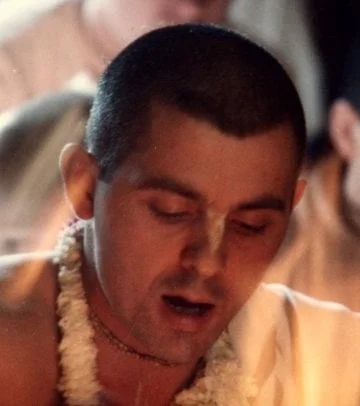
Kuladri Das
Legal name Arthur Villa
KuladriKuladri-dasKuladri Dasa
- President, New Vrindaban community (Marshall County, West Virginia)
- 1976–1986
- Registered agent, International Society for Krishna Consciousness of West Virginia, Inc. (named ISKCON of WV Inc. until 2008; merged 2008; dates of the role not given)
- Director, JAGA, Inc. (New Vrindaban corporation, 1995–2011; dates of the role not given)
- Director, vice-president and registered agent, New Vrindaban Village Association, Inc. (incorporated 2017)
Record summary
1 entry — 1 allegation.
Last reviewedBio
Kuladri Das (legal name Arthur Villa) was born in Pittsburgh, Pennsylvania, in 1949, into a Catholic family (UPI). He came to the New Vrindaban community in Marshall County, West Virginia, in early 1970 as a 20-year-old University of Pittsburgh student. In 1975 he commissioned a teakwood throne in Bombay for New Vrindaban’s deities (newvrindaban.com). He was president of New Vrindaban from about 1976 to 1986 (WVU Libraries). In 1982 UPI interviewed him as president of the 300-member community about its newly opened Palace of Gold. The Fourth Circuit’s 1993 opinion in the Keith Ham case refers to “Arthur Villa, president of New Vrindaban”. In September 2026 ISKCON News described him as “a longtime New Vrindaban figure who has recently moved back to the community”.
West Virginia’s business register lists Arthur Villa as the registered agent of International Society for Krishna Consciousness of West Virginia, Inc. and as a director of JAGA, Inc.; the register does not say when he held either role. Both corporations were among the New Vrindaban debtors in the Chapter 11 cases filed in 2002 (lead case In re JAGA, Inc.; see the Rose v. JAGA opinion and the Children of ISKCON case), and both were later merged into International Society of Krishna Consciousness – New Mathura Vrindaban, Inc. (in 2008 and 2011). He is also listed as a director, vice-president and registered agent of New Vrindaban Village Association, Inc., a non-profit incorporated in 2017. These are corporate roles; the register records no wrongdoing.
Sources (11)
- [1]UPI, Hare Krishnas' opulent palace unpopular with West Virginia neighbors (Leon Daniel), Apr 13, 1982
- [2]West Virginia University Libraries, Henry Doktorski, Compiler, Records regarding Kirtanananda Bhaktipada Swami and the New Vrindaban Commune, A&M 4646 — finding aid, Apr 17, 2025
- [3]Opinion, United States v. Ham, 998 F.2d 1247 (4th Cir. 1993), Nos. 91-5350, 91-5430 and 91-5870 (appeals of Keith Gordon Ham, Steven Fitzpatrick and Terry Sheldon), Jul 1, 1993 (document)
- [4]henrydoktorski.com, Timeline of Important Events for Gold, Guns and God, Killing For Krishna and Eleven Naked Emperors (Henry Doktorski) — author's book page
- [5]newvrindaban.com, New Vrindaban Sets Up A New Altar, Mar 29, 2024
- [6]ISKCON News, Kuladri Das Recalls His Time With Prabhupada – Part Three, Dec 28, 2012
- [7]ISKCON News, New Vrindaban Opens Its Doors for ISKCON's 60th Anniversary (Anuradha Dasi) — ISKCON New Vrindaban Communications, Sep 1, 2026
- [8]West Virginia Secretary of State, International Society for Krishna Consciousness of West Virginia, Inc. — business organization detail: incorporated 19 Feb 1998; merged 11 Sept 2008; notice-of-process address "Arthur Villa", checked 2 Oct 2026 · copy on this site
- [9]West Virginia Secretary of State, JAGA, Inc. — business organization detail: incorporated 28 June 1995; merged 24 March 2011; officers list "Arthur Villa" as a director, checked 2 Oct 2026
- [10]West Virginia Secretary of State, New Vrindaban Village Association, Inc. — business organization detail: incorporated 20 July 2017; annual reports 2018–2026; "Arthur Villa" as director, vice-president and notice-of-process agent, checked 2 Oct 2026 · copy on this site
- [11]Rose v. JAGA, Inc. et al., Civil Action No. 5:05CV166 (N.D. W.Va.), appeal in Bankruptcy No. 02-51295: Memorandum Opinion and Order vacating in part summary judgment and remanding (25 July 2006, Doc. 8), Jul 25, 2006 (document)
Record
1 entry · most established firstAlleged role in the 1986 conspiracy to murder Steven Bryant (Sulocana dasa)
A self-published history of New Vrindaban, Killing for Krishna (2018), and related writings allege that Kuladri, then New Vrindaban's temple president, helped plan the 1986 killing of dissident Steven Bryant (Sulocana dasa). The claims rest on the book and on accounts by self-described participants (Janmastami dasa, 2006; Jyotirdhama dasa, 2019), none tested in court; West Virginia University's finding aid repeats them and is not independent. Sworn testimony at Keith Ham's 1991 trial (transcript p. 833) says he told a witness after the murder that "it shouldn't have been done like that" and that he had told others "not to do it". No record has been found that Kuladri was ever charged, and no court, police agency or ISKCON body is known to have made a finding against him. He testified at Keith Ham's 1991 federal trial. No public response from him to the allegation has been found.
Who makes the allegation, and on what basis. The claims come from Henry Doktorski, a former New Vrindaban resident who has written its history. On his book page he quotes letters from Jyotirdhama dasa, who describes himself as a participant in the plot. In January 2019 Jyotirdhama wrote: “By the time Sulochan was murdered, we all knew that Radhanath and Kuladri were involved in the planning.” He gave a fuller account on his own blog in 2019. The author’s book page also attributes a remark to Kuladri, without date or context: “We have to finish this thing. As long as that guy [Sulochan] is walking around, he’s a threat to Bhaktipada.” In a draft chapter the author cites Dennis Gorrick’s 1991 trial testimony. On that basis he writes that Gorrick paid Thomas Drescher $2,500 in May 1986 “because Kuladri told him that Bhaktipada had authorized that payment”. The Fourth Circuit’s opinion says only that Drescher received $2,500 “from the New Vrindaban community, authorized by Swami”. None of these accounts about Kuladri has been tested in court.
The participants’ accounts. Jyotirdhama dasa (Joseph Pollock Jr.), who ran the community’s telephone switchboard, wrote in 2019 that Kuladri called him to a meeting and told him: “It’s all set. Everything’s in place. The swamis are on board. Gaura is helping with surveillance. We just need your help with the telephones.” He also says that in February 1986 calls involving Kuladri, Gaura Shakti and the swamis Radhanath and Tapahpunja accounted for a noticeable rise in switchboard traffic. He also writes that “sometime soon after the murder” Kuladri came into the front office “encouraging me to ‘get rid of’ telephone call records from recent months; specifically the outbound call records recorded by the STS-16. I hid them in a crawl space above the PBX.” This is his own account; no record confirming it has been found. Janmastami dasa wrote in 2006 that Radhanath Swami had delivered his speech ordering the killing to “Tirtha, Tapah Punja Swami and Kuladri many times before”, and in a 2008 e-mail quoted in a 2011 compilation that Kuladri “was VERY, VERY frightened by the time it was coming to ‘reaction time’”. These are the participants’ own accounts and have not been tested in court.
Accounts that point the other way. Dennis Gorrick (Dharmatma dasa), testifying for the prosecution at Keith Ham’s 1991 trial (Day IV, 14 March 1991, transcript p. 833), said that after the murder Kuladri (Arthur Villa) “was quite disturbed” and “had mentioned how he was very disturbed and how it shouldn’t have been done like that. And that how Mr. Slavin, Mr. Wheeler and Mr. Sheldon were pushing like crazy for this to happen, and how he had told them not to do it.” Gorrick said Kuladri had used their Krishna names. This is Gorrick’s sworn account of what Kuladri told him; the same draft chapter also quotes it, and says that a week after the murder Kuladri claimed Kirtanananda “knew nothing of the murder plot”.
His testimony. A 2011 compilation quoting the trial transcript gives this from Kuladri’s own testimony (Day III, 13 March 1991): “I know Tapahpunja, along with other swamis, were saying that the community had to do whatever is necessary to protect the Swami.” In 1993 the author of Killing for Krishna read the transcript of the 1991 federal trial of Keith Ham (Kirtanananda Swami) and quoted part of Kuladri’s testimony. That testimony concerned what Kirtanananda had told him in late 1986 about allegations of sexual conduct. Whether Kuladri testified under a grant of immunity has not been confirmed.
- 2006Reported allegationJanmastami dasa, a self-described participant, wrote that Radhanath Swami gave the order to kill Bryant in "a prepared speech that he had delivered to Tirtha, Tapah Punja Swami and Kuladri many times before" (as quoted in a 2011 compilation).
- 2018Documented allegationThe self-published history Killing for Krishna (2018) and related writings describe Kuladri as "a prominent leader in the conspiracy to murder Sulochan". The account rests largely on statements given to its author by self-described participants and on his reading of 1991 trial testimony. West Virginia University's 2025 finding aid calls him a "key player in the conspiracy to murder Steven Bryant"; it describes the collection the author compiled and donated and is not an independent source.
- 2019Documented allegationJyotirdhama dasa's first-person account says Kuladri recruited him to handle the plot's telephone communications, and that soon after the murder Kuladri encouraged him to "get rid of" the switchboard's outbound call records. This is the participant's own untested account.
No charge against him has been found. The Fourth Circuit's 1993 opinion in the Keith Ham case recounts the Bryant killing without naming him; it notes that "others involved in these incidents have been tried separately or granted immunity for their cooperation with the government", without naming them. Critic websites claim he testified under immunity; no court record or news report confirming this has been found.
Sources (13)
- [1]Henry Doktorski, Killing for Krishna: The Danger of Deranged Devotion (Henry Doktorski) — self-published; author's book page, 2018 original
- [2]henrydoktorski.com, Chapter 10: The Murder (Henry Doktorski) — from "Krishna Killers: The Danger of Deranged Devotion"; pre-publication chapter of Killing for Krishna, PDF, 2017 original
- [3]henrydoktorski.com, Timeline of Important Events for Gold, Guns and God, Killing For Krishna and Eleven Naked Emperors (Henry Doktorski) — author's book page original
- [4]West Virginia University Libraries, Henry Doktorski, Compiler, Records regarding Kirtanananda Bhaktipada Swami and the New Vrindaban Commune, A&M 4646 — finding aid, Apr 17, 2025 original
- [5]henrydoktorski.com — Hrishikesh dasa (Henry Doktorski), letter of 27 October 1993 quoting the 1991 trial transcript, Oct 27, 1993 original
- [6]krishna1008.blogspot.com, My Involvement in the Sulochan Murder (Jyotidhama dasa), Mar 21, 2019 original
- [7]henrydoktorski.com, My Involvement in the Conspiracy to Murder Steven Bryant: Reflections by the New Vrindaban Telephone Man (Jyotirdhama dasa / Joseph Pollock Jr.) — addendum to Killing for Krishna, Mar 21, 2019 original
- [8]The Sampradaya Sun, New Vrindaban History, for the Record (Janmastami dasa) — quoted by Krishna Dasa, 2011, Dec 22, 2006
- [9]Trial transcript, United States v. Ham et al., CR 90-87 (N.D. W.Va.), Day IV, 14 March 1991: title page, index and pp. 831, 833, 835 (testimony of Dennis Gorrick), Mar 14, 1991 (document) original
- [10]US District Court, Martinsburg, West Virginia, United States v. Keith Gordon Ham et al., CR 90-87 (N.D. W.Va.) — trial transcript, Day III (13 March 1991) p. 475 and Day IV (14 March 1991), court reporters Halasz & Halasz (transcript not seen; quoted by Krishna Dasa, 2011), March 1991
- [11]Prabhupada Vision, Radhanath Swami: Saint or Sinner? (Krishna Dasa) — blog; compiles quotations from the 1991 trial transcript, letters and interviews, Jan 15, 2011 original
- [12]henrydoktorski.com, Henry Doktorski reviews the film Krishnas: Gurus. Karma. Murder., Oct 24, 2023 original
- [13]Opinion, United States v. Ham, 998 F.2d 1247 (4th Cir. 1993), Nos. 91-5350, 91-5430 and 91-5870 (appeals of Keith Gordon Ham, Steven Fitzpatrick and Terry Sheldon), Jul 1, 1993 (document) original
Places
1Timeline
Each status change in this record, on one axis, with the periods of the cases Kuladri Das is involved in.
- 1986
- Case period1986–1994 The murder of Steven Bryant (Sulocana dasa), Los Angeles, 1986
- 2006
- Reported allegationDec 22, 2006 Alleged role in the 1986 conspiracy to murder Steven Bryant (Sulocana dasa) Janmastami dasa, a self-described participant, wrote that Radhanath Swami gave the order to kill Bryant in "a prepared speech that he had delivered to Tirtha, Tapah Punja Swami and Kuladri many times before" (as quoted in a 2011 compilation).
- 2018
- Documented allegation2018 Alleged role in the 1986 conspiracy to murder Steven Bryant (Sulocana dasa) The self-published history Killing for Krishna (2018) and related writings describe Kuladri as "a prominent leader in the conspiracy to murder Sulochan". The account rests largely on statements given to its author by self-described participants and on his reading of 1991 trial testimony. West Virginia University's 2025 finding aid calls him a "key player in the conspiracy to murder Steven Bryant"; it describes the collection the author compiled and donated and is not an independent source.
- 2019
- Documented allegationMar 21, 2019 Alleged role in the 1986 conspiracy to murder Steven Bryant (Sulocana dasa) Jyotirdhama dasa's first-person account says Kuladri recruited him to handle the plot's telephone communications, and that soon after the murder Kuladri encouraged him to "get rid of" the switchboard's outbound call records. This is the participant's own untested account.